



Although the concept is not entirely new, there has been a renewed interest in reverse recruiting over the past few years. I have found that many job seekers are still unfamiliar with this approach to landing a job interview. Even when they have heard something about it, they may not fully understand how it works and are uncertain whether they should try it. Today’s post will explore the role of the reverse recruiter and this approach to the frustrating and exhausting task of job searching.
Recruiters
Before discussing “reverse” recruiting, let’s look at how “normal” recruiting works. Most job seekers are somewhat familiar with the term “recruiter” in the traditional sense. Sometimes referred to as a “headhunter” (although there are differences), a recruiter is a professional used by a company to search for and attract qualified candidates for their open positions. Large employers may have their own recruiters, usually based in the human resources department, to perform this task. However, most companies typically hire outside agencies (search firms) that specialize in this service. Legitimate search firms are compensated by the client company looking for candidates, and there is no cost whatsoever to the job seekers.
How Are Recruiters Paid?
Search firms are paid on either a contingency or retained basis, or sometimes a hybrid of the two approaches. When contracted on a contingency basis, the search firm is paid only upon a successful hire, and typically receives about 20–30% of the first-year salary (again, paid by the company, not the person who was hired). When the search is for a high-level executive position, search firms are typically hired on a retained basis and usually charge an upfront fee for their services, plus, if a person is hired, an additional fee equal to about 30–35% of that person’s first-year total compensation package.
A recruiter may search for candidates’ resumes on popular job sites such as LinkedIn, Indeed, Zip Recruiter, Dice, Glassdoor, CareerBuilder, Monster, and many others. Some recruiters (”headhunters” in particular) may also directly contact currently employed individuals who do not have resumes posted on these sites and who may not be actively looking to change jobs. They search online resources such as company directories, professional organization membership directories, etc., for individuals currently working in the desired field and then approach them by email or phone. The recruiter informs the individual about the available position, explains why it would be a great opportunity for them, and then attempts to convince them to apply for an interview.
To summarize, recruiting, as normally performed, is an arrangement in which the recruiter is contracted by the hiring company to find qualified candidates and is paid for those services by that company, with no cost to the person who was hired.

Caution!
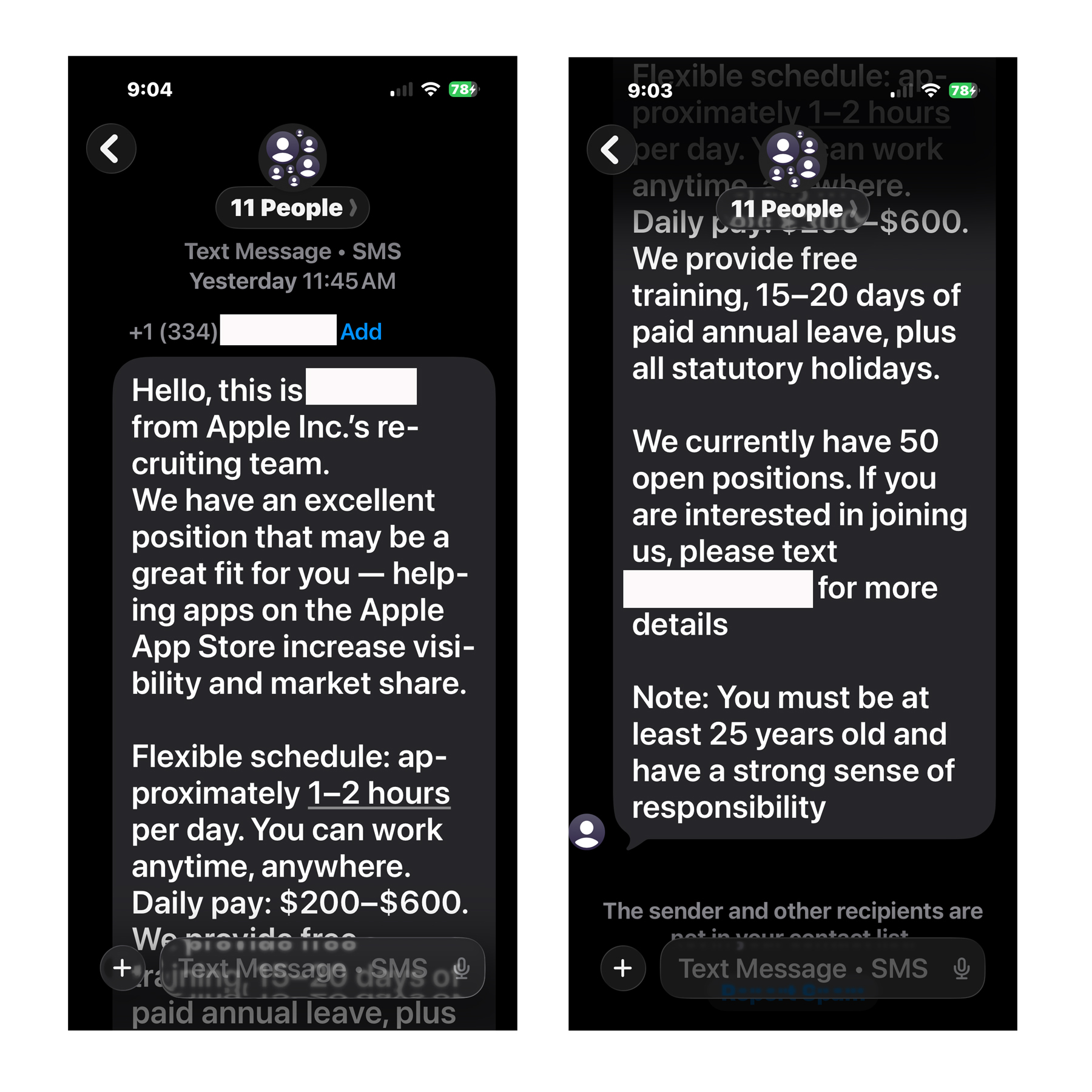
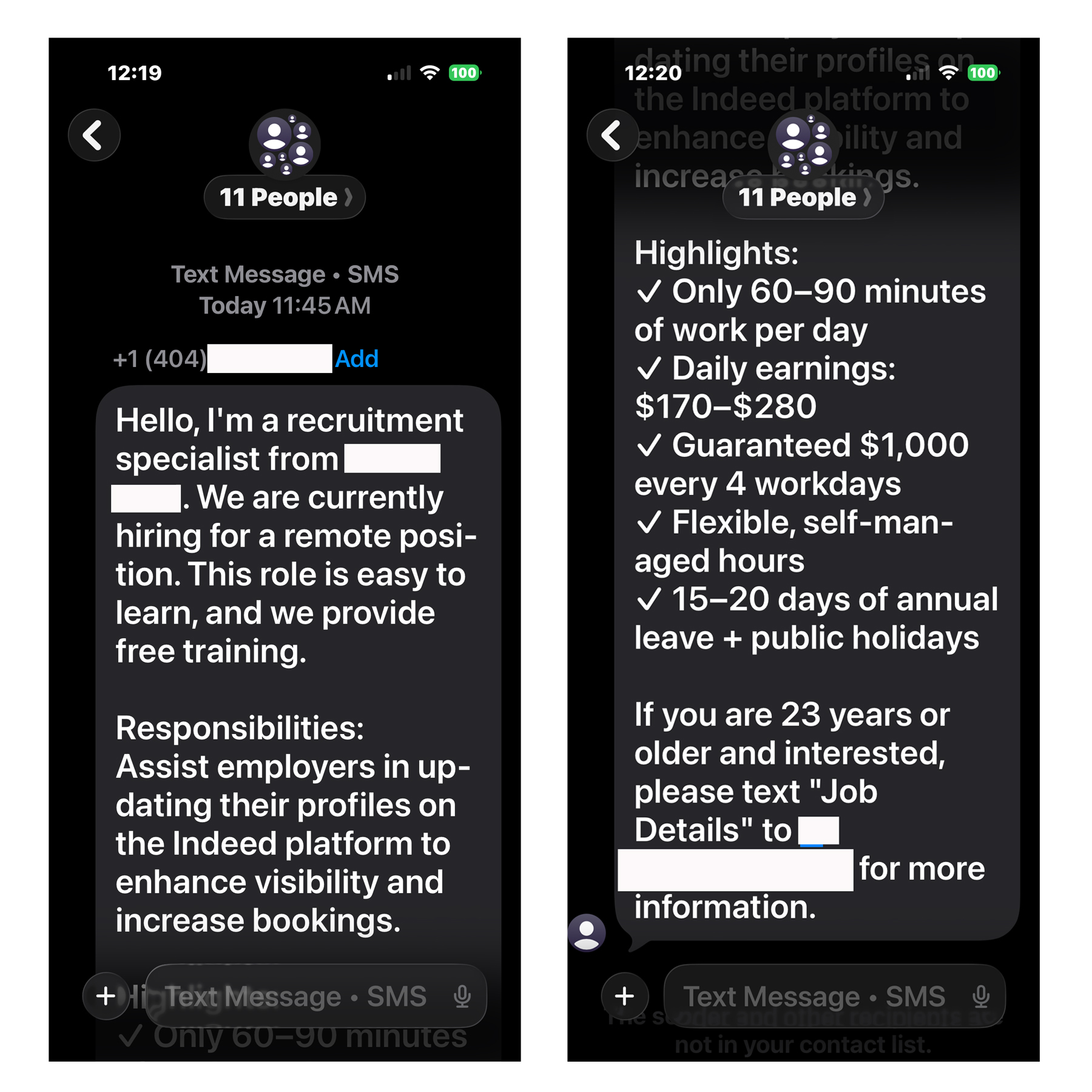
Scam emails and text messages from fake “recruiters” promising attractive jobs are on the rise. These are often nothing more than phishing efforts to obtain your personal and financial information for identity theft, or an attempt to charge you for applying to nonexistent jobs. A legitimate recruiter would never charge you anything or immediately ask for personal information. Should you get such an email or text about a job, do not respond, but instead:
- Contact the company’s human resources department to verify whether they are actually using that specific recruiter.
- Visit the company’s website to see whether the job opening is posted and then apply there.
Shown below are screenshots of two actual scam text messages someone received claiming to be from recruiters (contact information redacted).
Reverse Recruiting
In reverse recruiting, as the name implies, the arrangement is completely reversed: the recruiter works for the job seeker, not a company, and is paid by the job seeker for those services. The task of a reverse recruiter is to manage a job seeker’s search for a job, optimize the person’s resume, find available positions, submit applications for those positions, and secure job interviews. In return, a job seeker may end up personally paying a reverse recruiter a fee ranging from a few hundred dollars to $10,000 or even more, often with no guarantee of success. Why would a job seeker do this?
Job seekers are becoming increasingly frustrated and exhausted by submitting endless applications with zero responses. One reason for this could be the job market itself. According to the HR Executive website, the U.S. Bureau of Labor Statistics reported, “As of December 2025, unemployed workers outnumbered job openings by roughly 1 million, the widest such gap outside the pandemic since 2017.” Another factor could be the increasing number of “ghost job” postings flooding corporate and career websites (see the Career Lantern post on this topic). These non-existent positions result in applicants spending considerable time applying, usually with no chance of a response.
Consequently, unsuccessful job seekers may become desperate and believe that using a reverse recruiter will improve their chances of landing an interview. Some job seekers may think they are too busy to personally devote the amount of time required for an extensive job search and decide to pay someone else to handle it for them. Other times, to be blunt, a job seeker may just be lazy.
Some Considerations
When using a reverse recruiter, remember you are granting them permission to represent you in the job market and have access to a considerable amount of your personal information. They complete job applications in your name, have passwords to job sites that you use, and write resumes and cover letters under your name. Obviously, although this arrangement can offer convenience, it exposes you to potential danger should you unknowingly work with a reverse recruiter harboring criminal intent. Additionally, there is often no guarantee of securing an interview. The reverse recruiter may simply electronically submit hundreds of applications (perhaps many to ghost jobs), with no results, and you are still on the hook for payment. In addition to an upfront or monthly fee, some reverse recruiters may charge a percentage (possibly 20%) of your first-year salary.
Reverse Recruiting has its Controversy
While I am sure there are legitimate, professional reverse recruiters out there and satisfied individuals who have successfully used their services, this approach to job searching appears somewhat controversial among many professionals in the human resources and recruiting fields.
In a LinkedIn post, Sarah Johnston, founder of Briefcase Coach, an executive resume and career branding firm, states, “The ‘reverse recruiting’ trend is a scam. I’ve been saying it, and I’ll keep saying it.” She goes on to say, “Let’s call this what it is: predatory marketing wrapped in career coaching language.” Similarly, Tyler Kastelberg, founder of the real estate recruiting firm Bullpen, states in a LinkedIn post, “The success rate of reverse recruiting is very low, and recruiters who provide this service know this. Why do they offer it? … it’s easy money from people who are vulnerable.”
An online article by Forbes discusses some of the advantages of using reverse recruiters, but reminds job seekers that even when they use these services, they still have work to do. They state, “One factor to keep in mind is that there is still a time commitment. Although you won’t be manually submitting resumes, you’ll still need to actively engage with recruiters, provide input on job preferences and prepare for interviews.” The Small Business Association of Michigan highlights some advantages of reverse recruiting and states, “One of the major benefits of reverse recruiting is it saves a lot of time and energy, especially for those who are currently working while searching for new roles or are parents or caregivers. The average job search right now takes about 22-24 weeks, and some reverse recruiting firms claim to be able to cut that time in half for their clients.” However, the article also offers cautionary advice and says, “It could be dangerous for clients to give a reverse recruiter their login credentials for LinkedIn, Workday, and other job-seeking platforms.”
Final Thoughts
If you read the links to the articles above and do additional online searches, you will find sharply divided opinions regarding the pros and cons of reverse recruiting. Is a reverse recruiter right for you? Ask yourself the following:
- The overwhelming consensus appears to be that the services of a reverse recruiter are indeed expensive. Can you financially afford it?
- The services of a reverse recruiter may not come with any guarantee of success, but you may still have to pay. Are you OK with that?
- Sure, you may be frustrated so far that your online applications just seem to disappear into a black hole, but have you really put in the work and time necessary for a thorough job search? Have you already searched extensively for open positions and carefully tailored your polished resumes and cover letters for each position for which you applied?
- Do you need the comprehensive—and expensive—services of a reverse recruiter? Perhaps you only need assistance revising your resume or hiring a career coach to do practice interviews, as using these services alone may be more cost-effective.
- Since they represent you in the job market, are you comfortable sharing your personal information, job site passwords, etc., with a reverse recruiter and allowing them to submit job applications, resumes, and cover letters in your name?
- If you are considering a particular reverse recruiter, have you thoroughly vetted them to ensure they are legitimate and have a good record of success?
Only if you can confidently and honestly answer “Yes” to ALL of the above should you consider using a reverse recruiter.
Have you personally used a reverse recruiter? Feel free to share your experience!
If your comment is posted, we do NOT show your name or email address.
 Available in both paperback (8½ x 11 inches) and Kindle edition on